

To effectively design and orchestrate the agents on the AI Agent Platform, it’s important to understand the core concepts that shape how agents operate, interact, and are triggered. This section provides a high-level overview of key platform concepts, including core nodes, configuration, and agent hierarchy.
AI Agent Platform core nodes
The AI Agent Platform core nodes define how each agent interprets its role, when to invoke a specific skill or delegate to another agent, and how to produce contextually relevant outputs. Within these nodes, the Name, Description, and Instructions fields collectively guide not only the agent’s task execution but also its ability to make decisions based on available tools, skills, and routing logic.
AI Agent node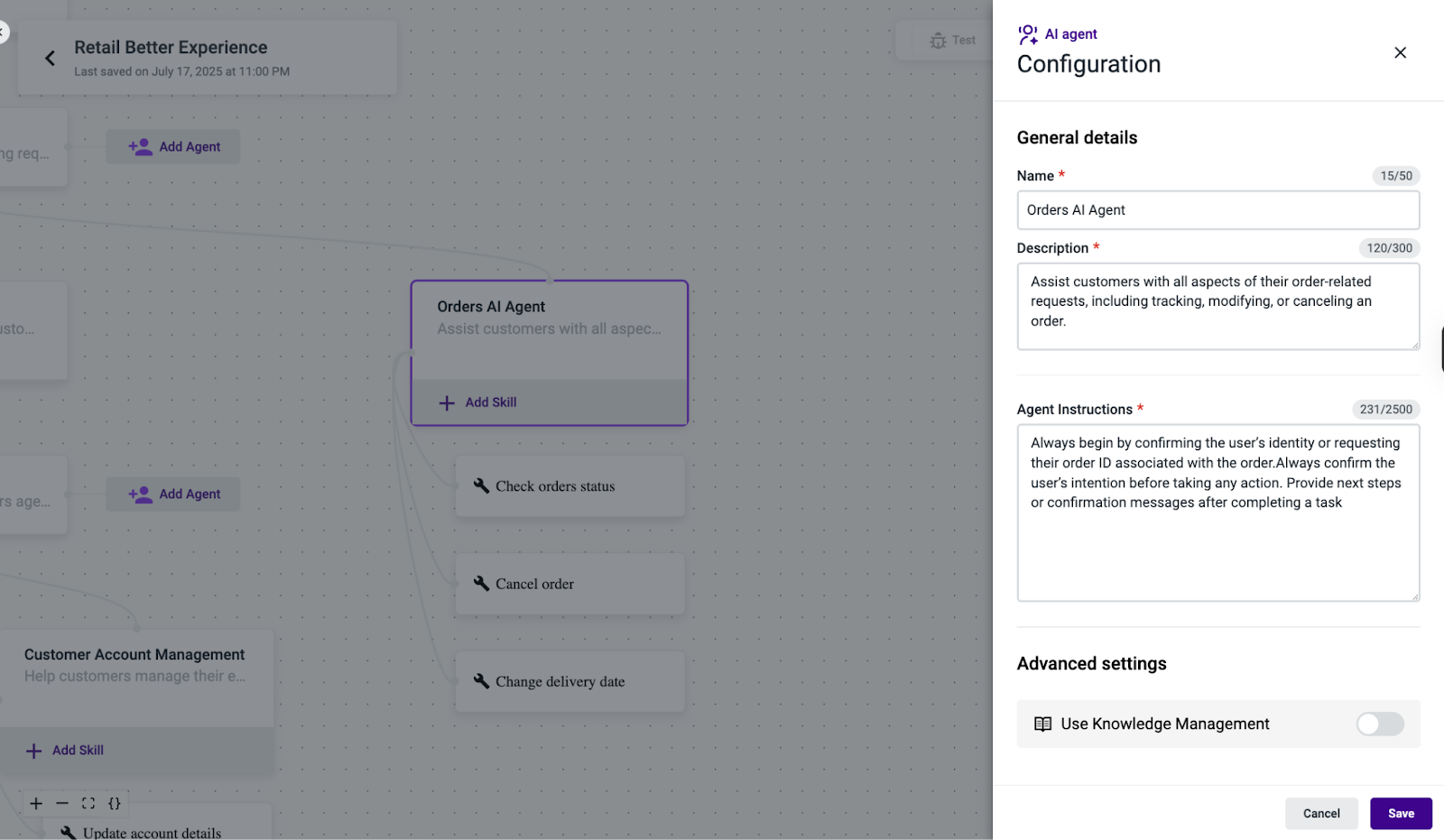
The AI Agent node defines an individual agent’s identity and behavior within a flow.
- The Name and Description fields are used by the parent AI Agent when a request is received to decide if this agent is appropriate to handle the request. They should not provide instructions on how the agent should act.
- The Instructions field allows you to define precisely how the agent should interpret inputs, process information, and formulate responses.
Conditions node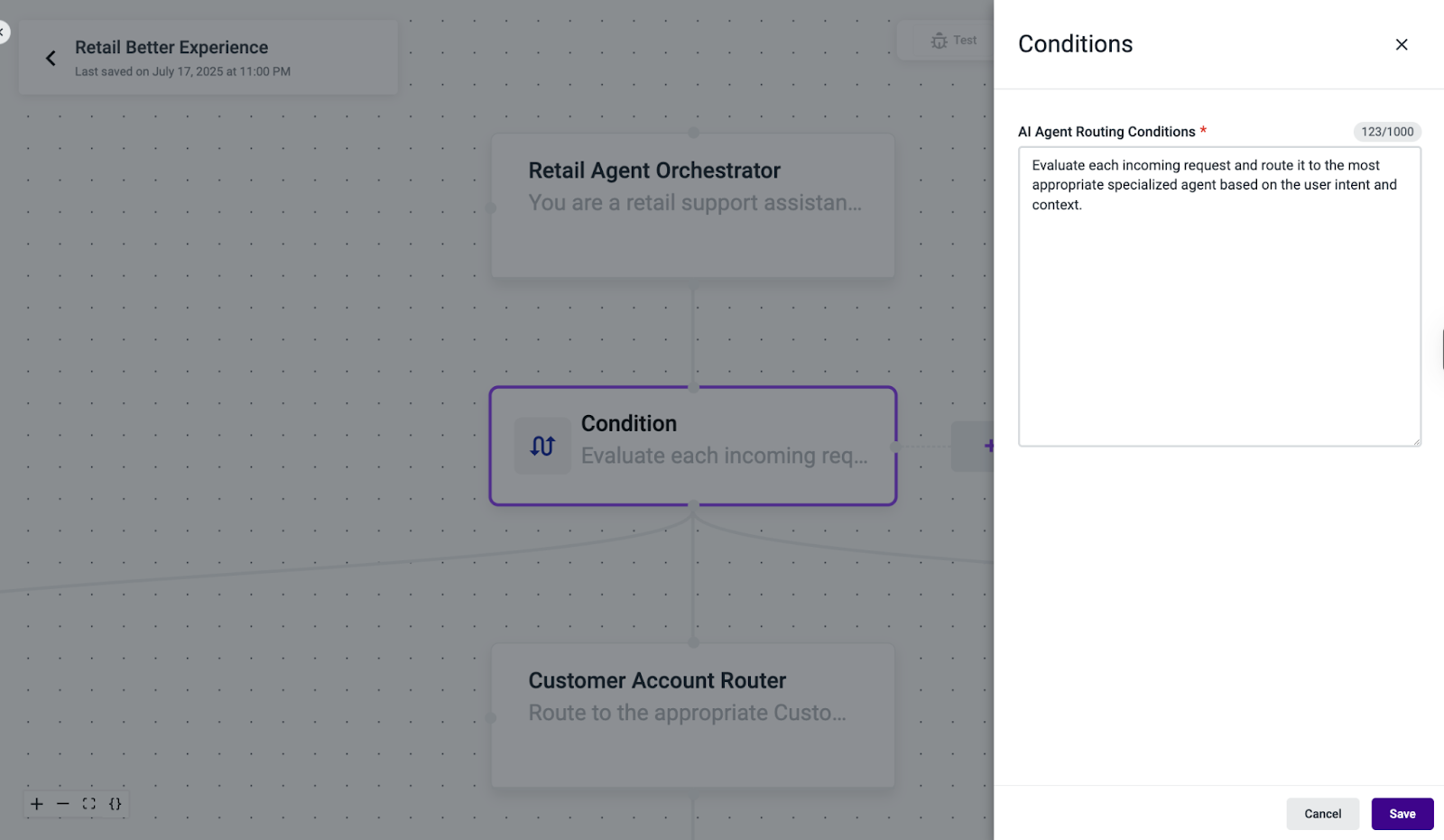
The Conditions node controls decision-making based on input messages.
- The AI Agent Routing Conditions field is used to determine when a child AI Agent should be invoked during processing. These conditions help route tasks to the most appropriate agent.
- The prompt for this field should describe when each child AI Agent should be called and it should refer to those child AI Agents by their defined name. It is normal to have some overlap between the Conditions node and the Description field of the AI Agent node.
- One important aspect to consider in the Conditions is the routing order. For example, ensuring that an identity verification agent is triggered before routing to other agents that handle specific user requests.
Skills node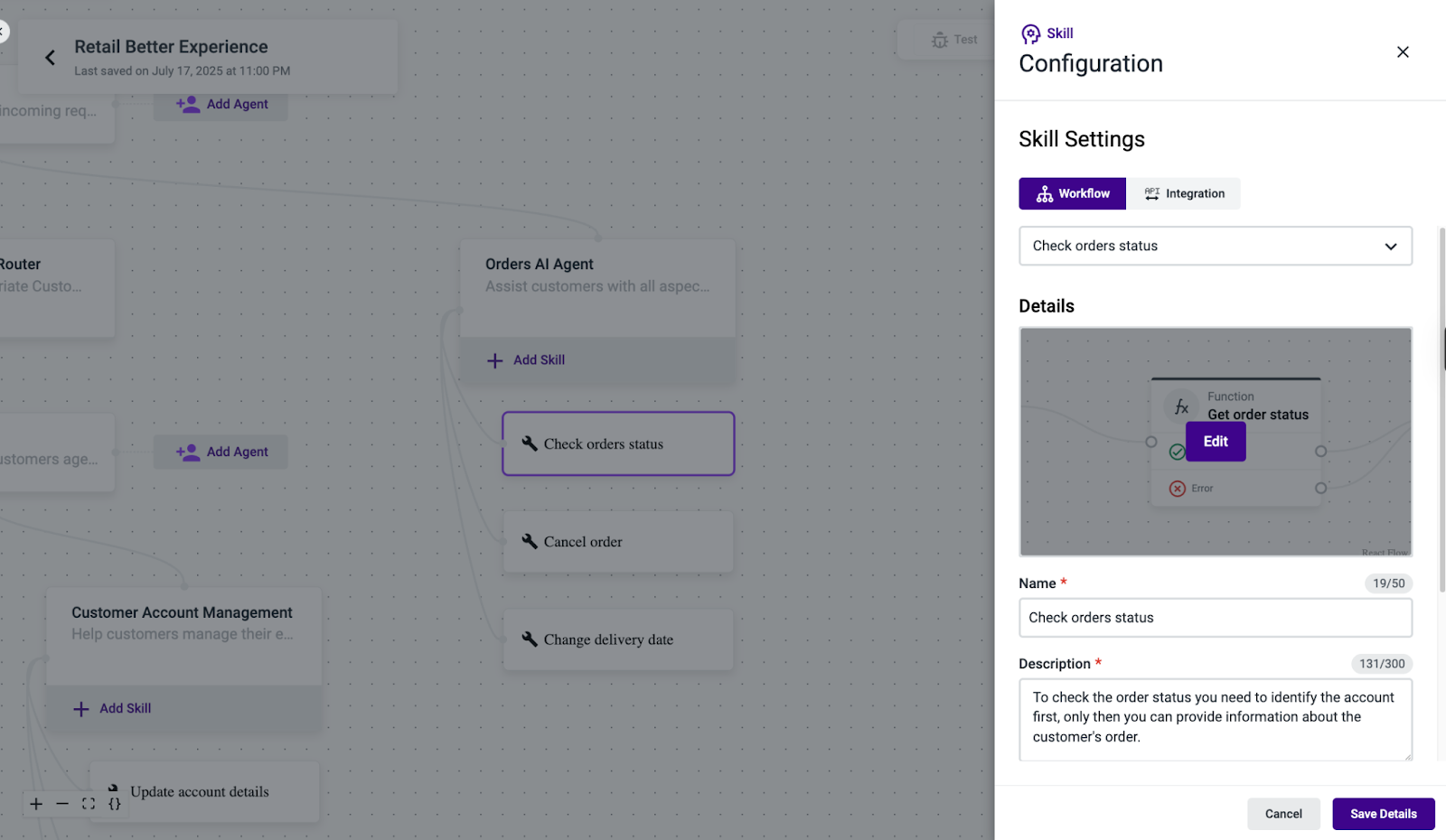
The Skill defines specific capabilities that an AI Agent can call upon to perform actions.
- The “Name” and “Description” fields are used by the agents to understand what the Skill does and when it should be used. The description should not be used to instruct on how to do the action.
- The “Inputs” field defines the information the AI Agent requires. AI Agents will try to fill these inputs with either information provided by the user or their own knowledge.
- The “Outputs” field specifies what the skill returns after execution. The AI Agent will use the output information for follow-up interactions.
Agent hierarchy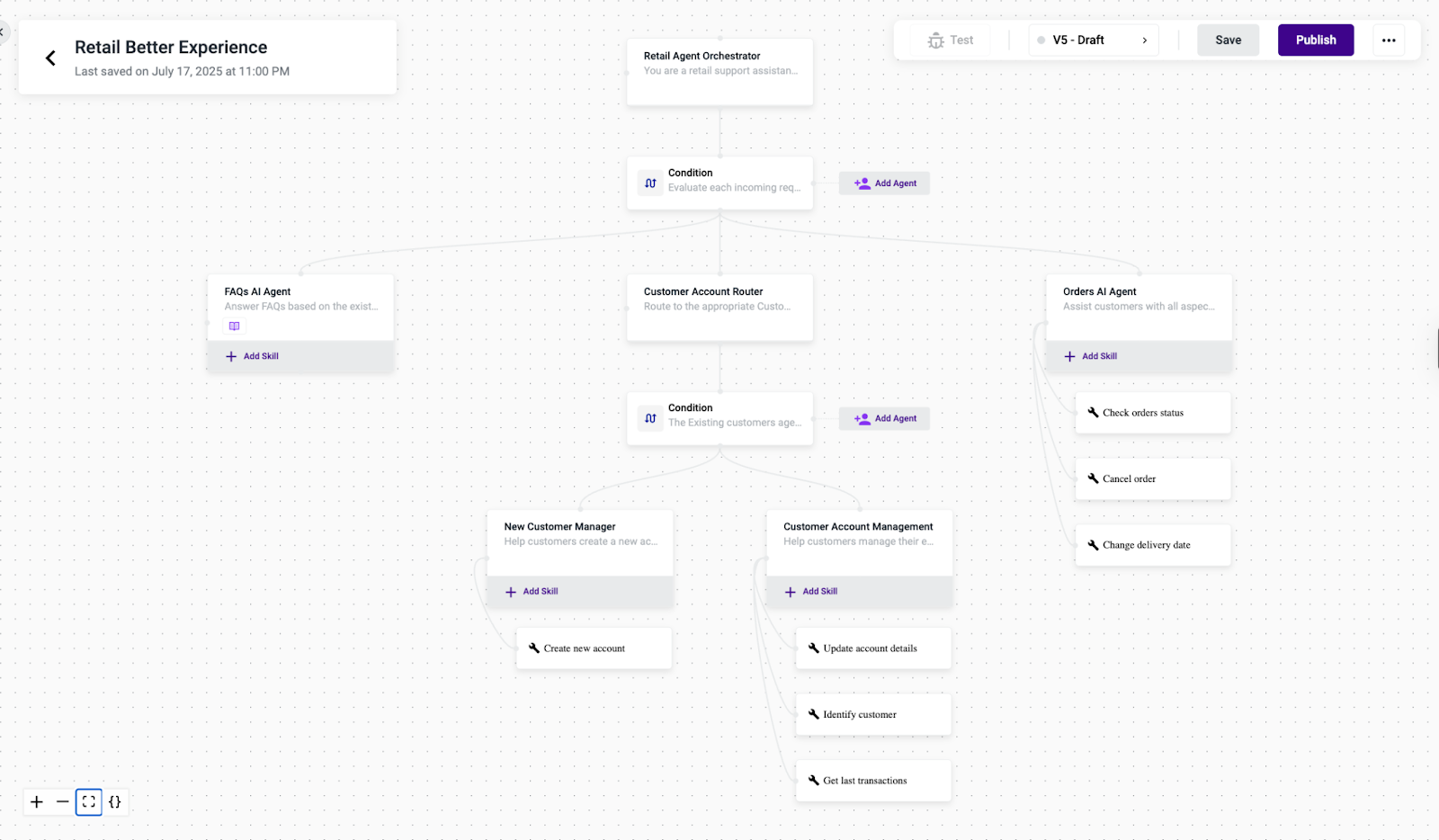
When a flow involves multiple agents, they are automatically organized into a three-level hierarchy to support complex task coordination:
-
Supervisor:
- Handles the user request inputs and coordinates other AI Agents to process the user request.
- The Supervisor is the top node on a multi-agent flow.
- The Supervisor is the only AI Agent that directly receives and sends messages to the final user.
-
Routing Agent:
- Acts as an abstract intermediary layer, enabling complex workflows that mirror organizational structures.
- The Routing Agent is created when an AI Agent node has a condition node below it, except the first AI Agent node, which is a Supervisor.
- This type of Agent is optional, and it is only needed when it makes sense to group more than one Action Agent (see description below).
-
Action Agent:
- Operates at the leaf level of the hierarchy. Responsible for generating specific task plans and coordinating skill-level automations.
Note: In the example displayed in the image above, the roles are:
- Retail Agent Orchestrator - Supervisor.
- Customer Account Router - Routing Agent.
- FAQs AI Agent, New Customer Manager - Action Agent.
When a Supervisor or Routing Agent needs to determine which Action Agent should handle a user request, it uses the AI Agent routing conditions defined in the Conditions nodes, along with the Name and Description fields of the AI Agent nodes, to identify the most suitable agents.
AI Agent Platform principles
In addition to understanding the platform’s structure and configuration, it’s important to grasp how AI Agents interact during execution. The following concepts clarify how Agents collaborate, delegate tasks, and share information within a flow. These principles are essential for designing Agents that work together effectively in multi-agent scenarios.
Multi-Agent collaboration in a single message
A single user message may involve multiple AI Agents collaborating to produce the final output. This is especially common in complex flows where different agents contribute to subtasks before the final response is returned to the end user.
Communication is hierarchical
An Agent can only dispatch a task to one of its direct child Agents or return a response to its parent agent. It cannot communicate directly with sibling Agents or with Agents in a separate hierarchy.
Skill Output is only known by the Action agent
The output of a skill is only accessible to the Action Agent that invoked it. If the result is relevant to other agents higher in the hierarchy, the Instructions of the Action Agent must include guidance on how to reply or explain that output in its response
Only the Supervisor communicates with the end user
Only the Supervisor is responsible for interacting directly with the end user. All other Agents communicate only with other Agents in the hierarchy. Because of this, each Agent’s instructions should be written with the correct audience in mind, whether it's another Agent or the end user, ensuring the output is framed appropriately for its recipient.